зміст
A case is often perceived as a simple box: so that it closes, so that the equipment fits – and that is enough. But it begins to “work” already on the road, and if it is chosen randomly, this quickly becomes a problem: the equipment shifts, small elements get lost, and instead of convenience, constant control appears.
And the most unpleasant thing – most of these situations arise not because of transportation, but because of the wrong choice at the very start.
Here are 5 mistakes that most often lead to this.
Mistake 1. Choosing a case only by size
The simplest logic: “the main thing is that it fits”.
It seems that this is enough. But in practice, this is exactly where problems begin.
If there is free space inside – the equipment does not lie, it lives its own life. It moves – shifts, brakes – displaces, receives an impact – hits the walls or other elements.
As a result:
- play appears
- parts rub against each other
- the case inside receives micro-impacts
- the equipment wears out faster than it should зношується швидше, ніж повинна
Therefore, a case is not about “it fits”. It is about nothing moving.
Mistake 2. Ignoring the insert
There is a feeling that the main thing is a strong case, and everything else is secondary. But in practice it is the opposite: the case withstands impacts from the outside, and the insert is responsible for what happens inside. Without it, the case essentially becomes a box where the equipment lies however it happens.
And this is exactly where problems begin: the equipment shifts, hits each other, small parts get lost, and every opening turns into a search. The point of the insert is not appearance, but that there is order inside and nothing creates unnecessary problems in work.
Mistake 3. Not taking into account transportation conditions
The same case can work perfectly, or not work at all. It all depends on how it is used.
A case for storage and a case for constant transportation are different tasks, because on the road it constantly receives impacts, vibrations, and loads, and if this is not taken into account, even a normal case quickly begins to lose its reliability
Briefly, the difference looks like this:
| Condition | What happens | What is required from the case |
|---|---|---|
| Storage | Minimal load | Basic protection |
| Periodic transportation | Moderate impacts and movement | Fixation + strength |
| Constant logistics | Vibrations, impacts, loads | Rigid construction + insert |
Mistake 4. Focusing only on price
This is the most dangerous mistake, because it looks like a rational decision.
“Why overpay if it can be cheaper?”
In more affordable solutions, the following may be used:
- simpler case materials
- basic hardware
- universal internal filling without precise fixation
- limited lifespan under regular use
At the start, this difference may be not obvious. But with regular use, it becomes noticeable that a more thought-out and higher-quality solution works more stably and gives more confidence in transportation.
As a result, it is not only about price, but about how reliable the case is and whether it corresponds to real working conditions.
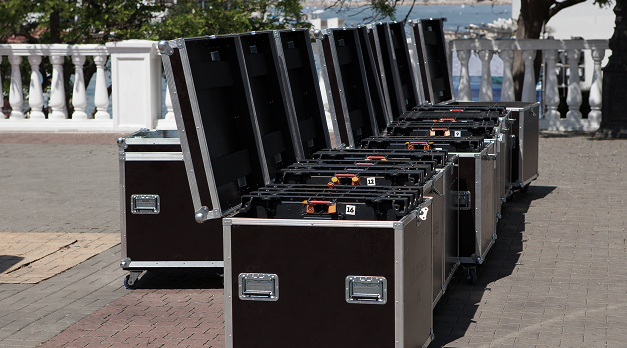
Mistake 5. Choosing a universal case for a non-universal task
Universal cases work as long as the task is really simple. But as soon as the equipment becomes more complex, more elements appear, or transportation becomes regular – compromises begin.
Such a case simply fits the equipment, but does not solve the main task – it does not fix it, does not provide full protection, and does not simplify the work. As a result, you have to constantly control, check, and adapt. And at some point it becomes obvious: there is a solution that simply “fits”, and there is one that really works.
How to approach choosing a case correctly
To not guess, it is enough to answer a few simple questions:
- What exactly you transport
- How often it moves
- How sensitive it is to impacts
- Whether there are small elements є дрібні елементи
And only after that select the case, insert, hardware, and the case format for a specific task. To start — the main thing is to understand the task
-
An insert is an individually formed internal insert that fixes equipment inside the case. Unlike a regular foam padding, it is manufactured for specific dimensions of devices and takes into account their shape, weight, and features of use.
-
Yes, we specialize in manufacturing cases based on an individual request. We carefully take into account the parameters of your equipment, its purpose, operating conditions, and wishes regarding appearance. This allows creating a solution that ideally suits you — both in functionality and in design.
Conclusion
Mistakes when choosing a case rarely look serious at the start. Everything seems ok: it closes, looks normal, the equipment is inside.
But on the road everything falls into place.
If the case is chosen incorrectly:
something moves, something hits, something constantly needs to be controlled.
A good case is when you do not think about it at all. It just works.